
Scenario-based learning: decisions in real situations, solo or as a team
You cannot learn what people do in a crisis from a quiz. In a scenario game a team handles one incident: each player has a role with their own information on the phone, a central screen plays the story, and meters show what every choice does. Or play it alone, with virtual colleagues.
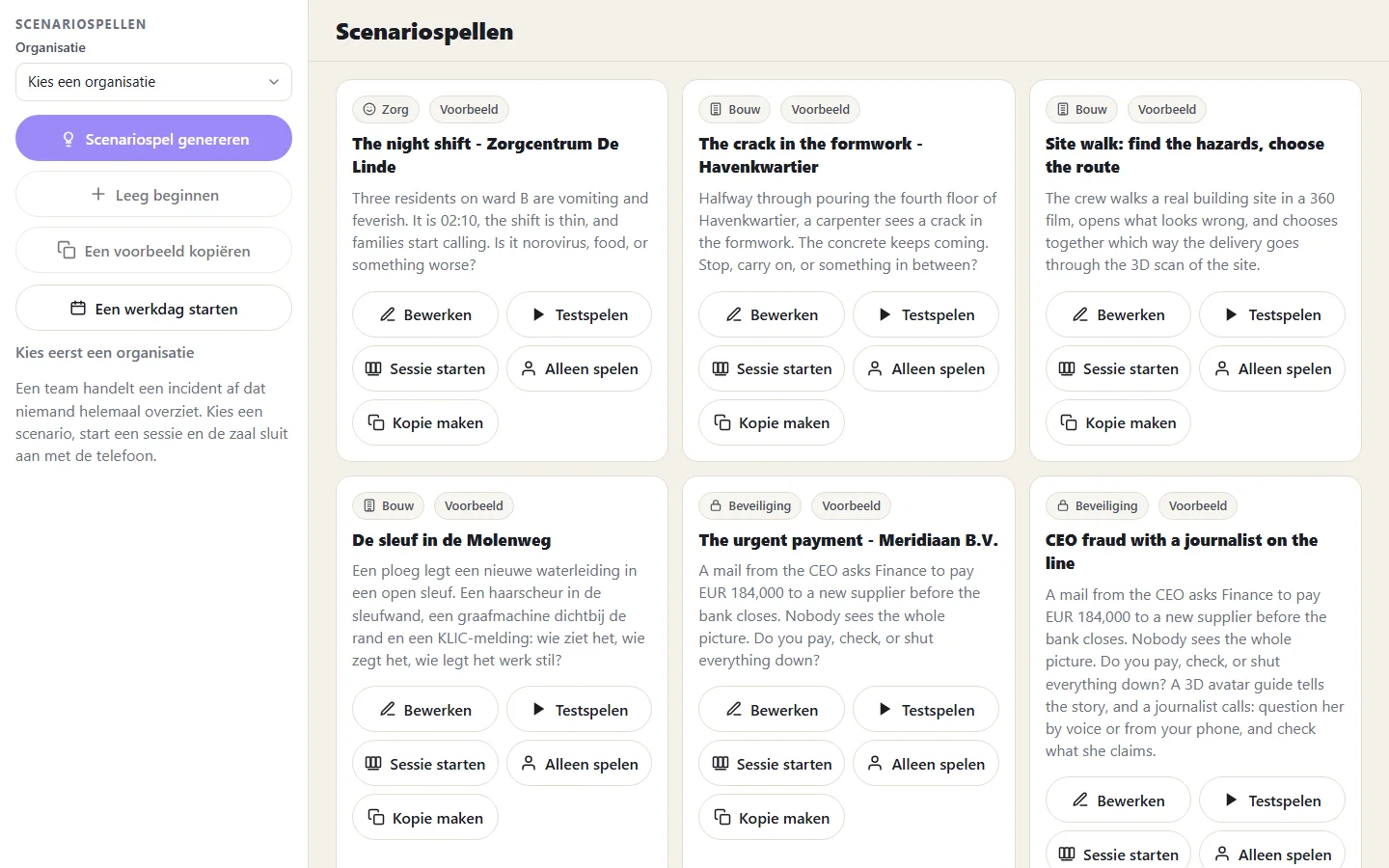
The night shift at Zorgcentrum De Linde
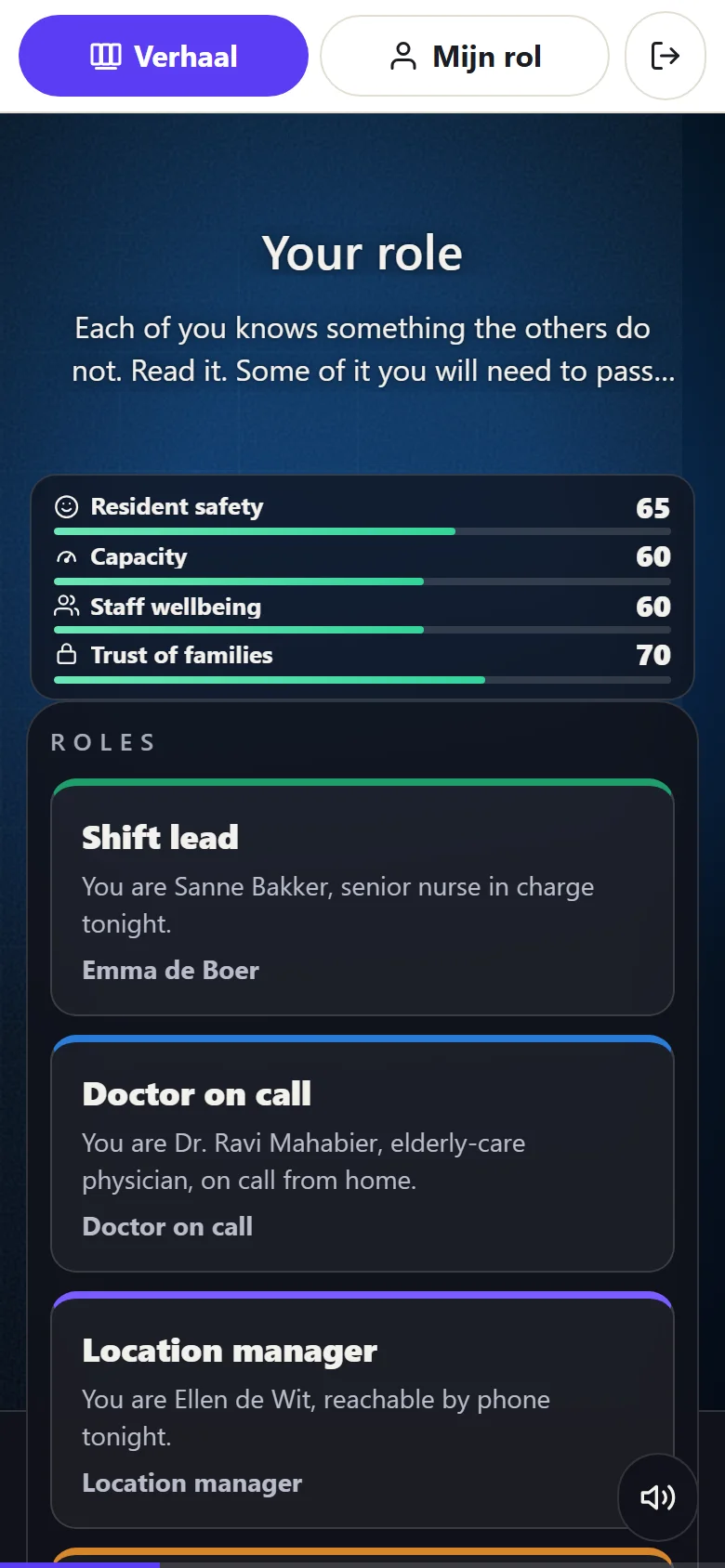
At 02:10 a carer reports fever in three residents on one ward. The team plays The night shift: the shift lead, the nurse and the on-call doctor each see something different on their phone. Their combined choices drive the meters for resident safety, capacity, staff wellbeing and trust of families.
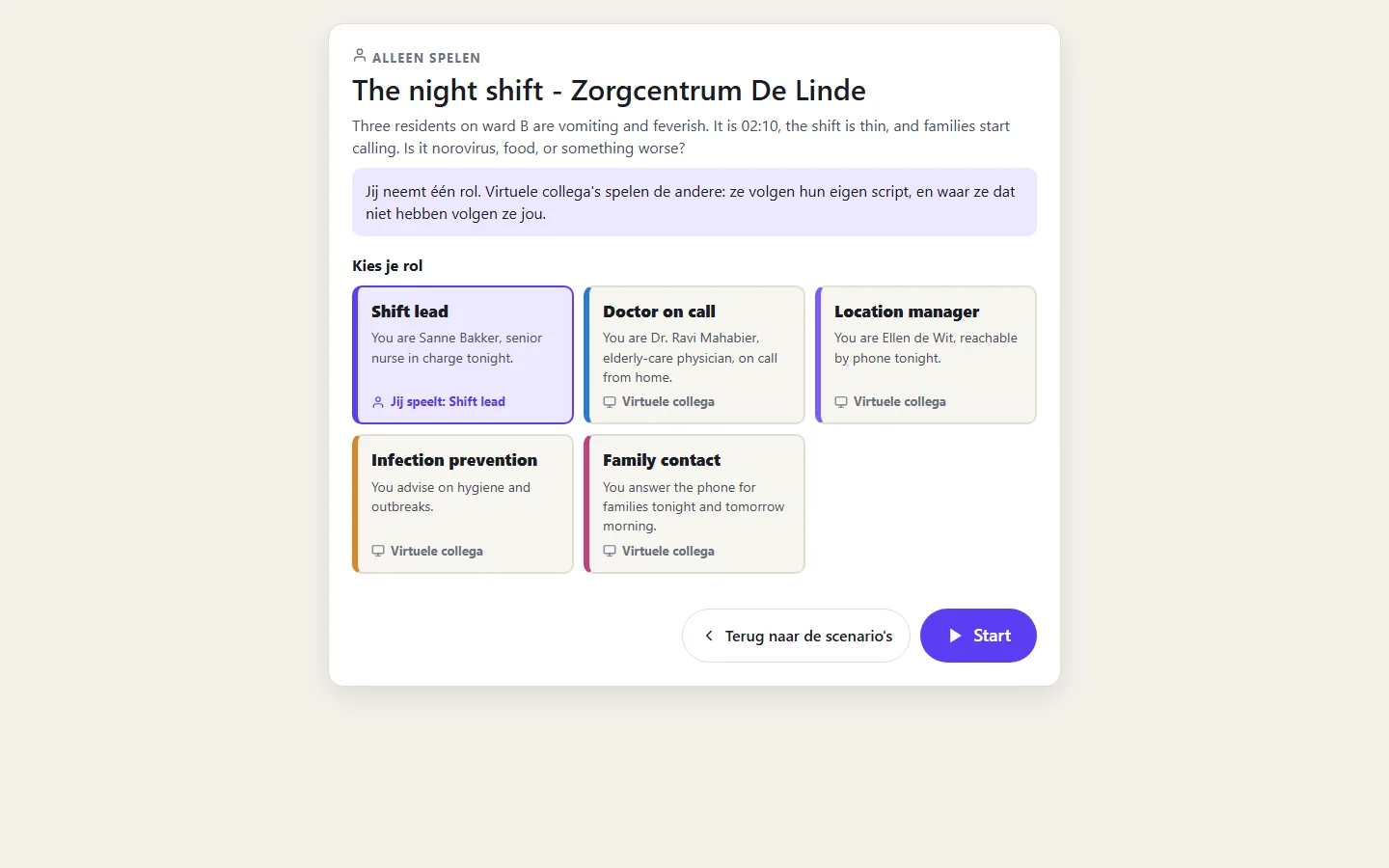
There are several endings. Then comes the debrief: who knew what, when, and what the team did with it. Anyone who wants to play alone picks a role and virtual colleagues play the rest.
Scenario-based learning: what you get
Real decisions
Choices move meters and decide the ending. A deterministic engine, so the same choices give the same result.
Together or alone
As a team with roles and secret information, or solo with virtual colleagues; there is also a workday mode with a virtual colleague.
A debrief that teaches
Who knew what, when: the conversation after the game is where the insight happens.
Your own scenario, fast
Examples for care, construction and cyber are ready; the AI wizard drafts your own scenario to finish in the editor.
How it works in CoVince
Pick or build a scenario
Start from an example (CEO fraud, night shift, formwork, trench work) or let the AI wizard draft one.
Run the session
A central screen plus phones, auto-run or with a game master; or solo play.
Debrief and measure
A debrief per session; the teacher view shows players, scores and interventions, and results are kept.
Frequently asked questions
What is scenario-based learning?
Learning by making decisions in a realistic situation and seeing the consequences, instead of looking facts up. In CoVince this happens in scenario games, solo or as a team.
Which sectors is it for?
Anywhere deciding under pressure matters. Examples are ready for care (a night shift with an outbreak), construction (formwork, a site walk, trench work) and cyber security (CEO fraud, a press call).
How many people play?
A team plays together, each with a role on their phone and a shared central screen. Solo works too: virtual colleagues play the other roles.
Is there VR?
VR is built in Unity, separate from the web platform; scenarios play in the browser or with a VR headset. 360 video and 3D scenes also work in the browser.
Read more on the blog
Goes well with
See how this works with your own material?
In a demo we build a first learning journey from your topic or document together, and show how practice and measurement fit in.
Half an hour, with your own learning goal as the example.